The Manchester Food Dictionary
By EATMCRManchester has never really had a single dish to define it. You really don’t have to look very hard to find traces of Greater Manchester's food culture though.
Manchester has never really had a single dish to define it. You really don’t have to look very hard to find traces of Greater Manchester’s food culture though.
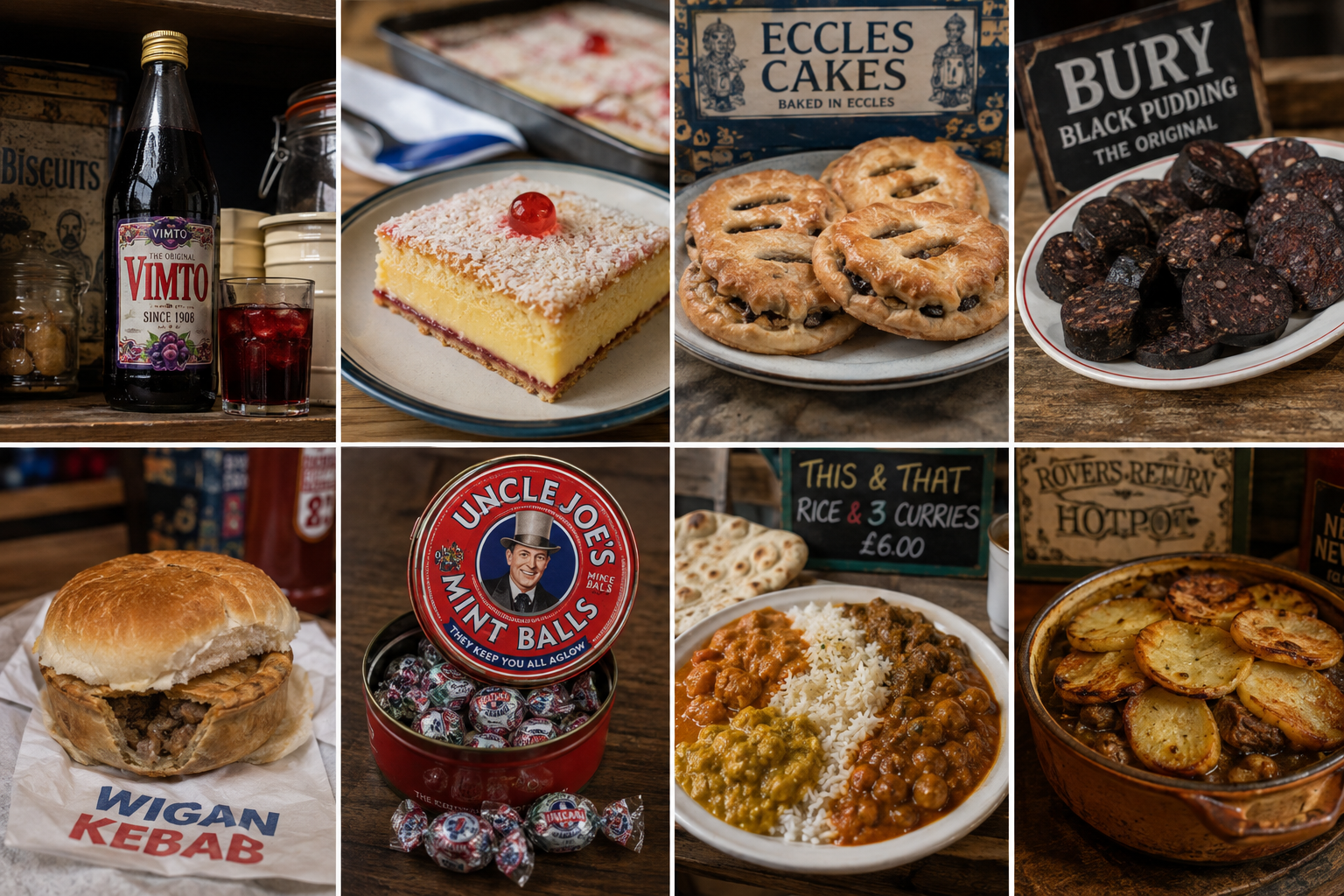
Vimto still occupies kitchen cupboards, Eccles Cakes continue to appear in corner shops nowhere near Eccles, and every September people gather in Ramsbottom to throw black puddings at Yorkshire puddings in a tradition that’s just as popular as it is an oddity.
Some were invented here, others delicacies simply settled in and never left. Either way, they’ve earned a place in the dictionary.\
Vimto
There are few things more Northern than a bottle of Vimto tucked away in every household’s cupboard with an M postcode. It has always just been there. In the cupboard. In the fridge. At your nan’s. At a birthday party. Or a hot ‘vimmy’ when you were ill, and it always fixed you up.
Created in Manchester in 1908, Vimto has gone on to become one of the city’s most successful exports, with a giant bottle on Granby Row still marking where it all began.
Its story didn’t stop in Manchester either. It unexpectedly became the iconic drink of Ramadan across the Middle East, served ice cold at Iftar after sunset.
Still, for most Mancs, it starts much closer to home, which is usually next to the squash.
Manchester Tart
Manchester Tart is famous. That does not necessarily mean everybody was thrilled to see it in front of the dinner lady.
For a lot of people, its strongest association is not a bakery window or a proud family recipe. It is a school dinner tray. Pastry, jam, custard, coconut and a cherry on top that was doing a lot of the heavy lifting on this dessert.
Some people loved it. Some people pushed the coconut around and waited for the bell.
Its roots go back to Manchester Pudding, a Victorian dish that eventually evolved into the version most people recognise today. Plenty of people could tell you what a Manchester Tart is. Far fewer are ordering one every weekend.
Manchester Tart may not be Manchester’s best-loved food, but it is probably its most famous pudding. There’s a difference.
Eccles Cake
Eccles Cake is probably the most successful thing ever to come out of Eccles.
No disrespect to Eccles. It’s more a reflection of how far the cake has managed to travel.
The small, flaky pastry filled with currants has spent more than 200 years carrying the town’s name around Britain. First sold in the town by local baker James Birch in 1793, Eccles Cakes have been turning up in bakeries, cafés and corner shops far beyond Greater Manchester ever since. Plenty of people could tell you what an Eccles Cake is. Far fewer could tell you where Eccles actually is.
That’s quite an achievement for a pastry and a handful of currants.
Eccles Cakes don’t come with much debate. Nobody argues about who makes the best one. Nobody is trying to reinvent them. They’ve never really felt the need to change.
And after more than two centuries, that seems to be working just fine.
Bury Black Pudding
Most towns would be happy being known for a market, but Bury has become known for what people buy at it.
For generations, people have travelled to Bury Market specifically for black pudding, taking home enough of it to convince anyone that blood sausage is a perfectly normal thing to spend a Saturday morning thinking about.
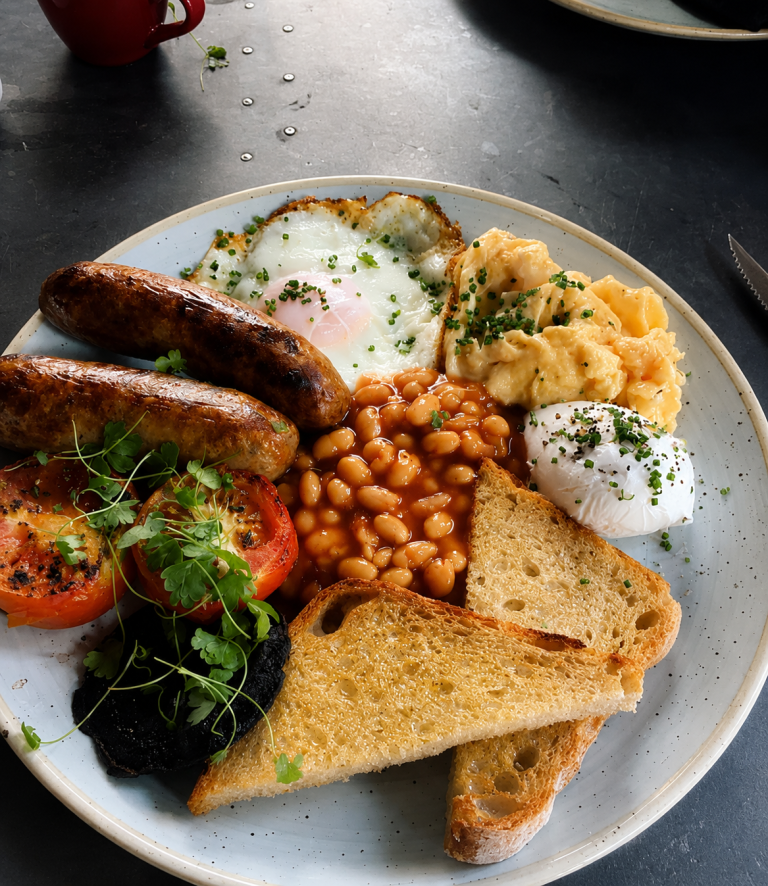
The town has become so closely associated with black pudding that it’s easy to forget how unusual that actually is. Most local foods stay local, but Bury Black Pudding became part of the town’s identity and found a rightful place on the full English plate.
Then there’s Ramsbottom’s annual World Black Pudding Throwing Championships.
What started as a local tradition has become one of Greater Manchester’s more unusual annual events, with competitors throwing black puddings at stacks of Yorkshire puddings in an attempt to knock them from a platform.
No, we’re not entirely sure why either.
The fact local producers are now making vegan versions would probably have baffled a few generations of market traders.
Some things change, but Bury’s relationship with black pudding certainly isn’t one of those things.
Wigan Kebab
Explaining a Wigan Kebab to somebody from outside Greater Manchester usually gets the same reaction.
A pause. Then a slightly confused look with a raised eyebrow. Then the inevitable question. “Where’s the kebab?”
The answer, of course, is that there isn’t one.
A Wigan Kebab is a meat and potato pie served inside a buttered barm. To anyone unfamiliar with the concept, it sounds completely ridiculous. But for Wiganers, it makes perfect sense.
The town had already built a reputation around pies long before the kebab arrived. At some point, somebody simply looked at a pie and decided it needed a carbohydrate sidekick.
The result has become one of Greater Manchester’s most recognisable food oddities, confusing visitors and delighting locals in equal measure.
Uncle Joe’s Mint Balls
Uncle Joe’s Mint Balls have spent more than a century ignoring trends.
The name hasn’t changed, the packaging hasn’t changed much, and the chances are the way you first discovered them hasn’t changed either. Usually through a grandparent or a coat pocket.
First produced in Wigan in the late 19th century, the sweets have become one of Greater Manchester’s most enduring brands.
Even the slogan became part of growing up for plenty of people. “They keep you all aglow.”
And like the sweets themselves, and thankfully, neither has the dapper smiling man on the packet.
Rice and Three
Long before the Northern Quarter became Manchester’s unofficial brunch capital, people were queuing for Rice and Three.
The dish exploded in popularity across the area during the 1980s, with curry cafés serving plates of rice and three curries to students, market traders, office workers and just about anyone else looking for a proper lunch that wouldn’t empty their wallet.
Places like This & That, Kabana, Little Alladin and Yadgar became institutions in the process.
You picked your curries, found a seat and got on with your day. Just ignore the menus; they’re usually out of date, but the star of the show is always right in front of you.
Regulars wouldn’t have it any other way.
Lancashire Hotpot
The classic Lancashire Hotpot has always been the fictional meal I’d want to try the most. Sat in the Rovers Return with a pint of Newton & Ridley and one of Betty Turpin’s hotpots just feels idyllic.
We’ve all got Betty to thank for making one of television’s most famous dishes.
Now, before anybody points it out, we know Lancashire Hotpot isn’t technically from Manchester. The clue is very much in the name.
But some foods end up becoming part of Greater Manchester’s story anyway.
Long before food television became a genre of its own, Betty was serving hotpot behind the bar of the Rovers Return to millions of viewers several nights a week.
The recipe itself goes back much further. Lamb, onions and sliced potatoes layered together and left to steam. Perfectly soft potatoes underneath, but brilliantly crispy on top. Like many Northern dishes, it was built around simple ingredients, long cooking times and making sure nobody left the table hungry.
Coronation Street simply gave it a bigger audience.
Manchester Egg
Some foods take generations to develop, whereas the Manchester Egg feels like it was invented somewhere between a pint in The Britons Protection and missing the last tram home.
A pickled egg wrapped in black pudding, sausage meat and breadcrumbs sounds less like a recipe and yet somehow it works brilliantly.
Created by chef Phil Tickle at The Oak House in the late 2000s, the Manchester Egg is one of the youngest entries in this dictionary by some distance. Unlike Vimto, Eccles Cakes or Manchester Tart, it doesn’t come with generations of family memories attached.
Instead, it earned its place the old-fashioned way, by being good enough to stick around.
Despite sounding completely ridiculous on paper, it feels surprisingly logical once it’s sitting in front of you. Black pudding already had its place in Greater Manchester. Pickled eggs were hardly strangers to pub counters. Somebody simply decided to introduce them properly, and we salute you for doing so.
Rag Pudding
Rag Pudding doesn’t leave a lot to the imagination, which is probably part of its charm.
A staple across Oldham for generations, the dish consists of minced beef and onions wrapped in suet pastry before being steamed in cloth, which is where the name comes from.
There are no surprises here, which is exactly the point.
It’s hearty, filling and built around the sort of ingredients that have fed mill towns for generations.
It might not be the most famous food in this dictionary and this is probably the first time you’ve heard of it, but fame was never really part of the job description.